
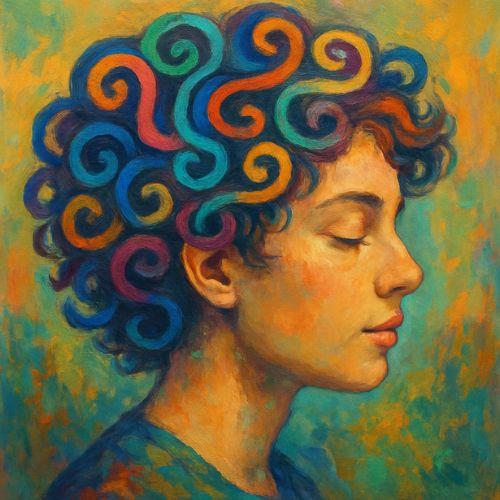
Pseudoscientists and Their McNugget Theories.
I was born in the ’80s. I didn’t hear the word autism. But then, I didn’t hear anything about climate change, axolotls, or the retinoblastoma gene (RB1) either.
Not because they didn’t exist. They just hadn’t been named by the West yet.
In the ’80s, neurodivergent people were ignored, misdiagnosed, institutionalised, or bullied into silence.
So no, I didn’t hear the word autism growing up.
But I felt it.
I learned how to mask at a young age. I learned quickly how to copy the other kids, hide my overwhelming anxiety in social situations.
I learned to laugh when I didn’t get the joke.
Later, I learned to make a joke when I felt uncomfortable.
Later still, I learned silence.
Silence, even when my body wanted to scream or shut down. Even when I wanted to speak.
I won’t bore you with the depression that stemmed from it. Or the rock-bottom confidence levels I still battle with daily.
It was only in my forties and with River by my side did I start to understand why I’d always felt so isolated, so other, so wrong in spaces where everyone else seemed to move effortlessly. Enjoy even.
What I needed back then wasn’t a cure.
It was just understanding. Language. Community.
To have been seen. For someone to ask how I felt, what I thought—and pause long enough to wait for an answer.
I just didn’t think in the same way as the other kids in my class. And why should I? Because you think so?
Why are you so caught up in the idea that we should all think in the same way? That there is a “right” way to think and that you’ve been blessed with it?
I was undiagnosed. Lost in a system that didn’t understand me.
River was misdiagnosed:
I was born at a time when only boys were autistic and only boys had ADHD. I was high achieving, but my room, backpack, and locker were always a disaster. I would lose assignments, but be able to get them done under my desk before the teacher asked.
When I inevitably, eventually, and spectacularly burned out there was no suggestion of neurodivergence but instead I was put on heavy medication and given a bipolar and BPD diagnosis.
This is the story of so many AFAB folks who are autistic. When I finally figured it out the damage had been done so to say.
I spend a lot of time unlearning things that are ingrained because I grew up neurodivergent presumed neurotypical.
I feel incredibly lucky because a lot of my creativity, empathy and passion comes from being neurodivergent. While there are still struggles having to do with sensory sensitivities, meltdowns, freezing when stressed. I am also able to see things from a different perspective to many.
If I were raised with the understanding that I am autistic I probably would be a more well-rounded and better adjusted adult. I’m lucky that I have my wife and some key people in my life who have stuck with me no matter what, but habits are hard to break,
While I know I am not representative of autism as a whole, I know speakers and non-speakers alike that are eloquent, intelligent, kind and talented humans.
Many alternative thinkers have done wonderful things for this space we inhabit.
Greta Thunberg. Sir Anthony Hopkins. Hannah Gadsby. Satoshi Tajiri. Jacob Barnett. Armani Williams. Tiffany Hammond. There are many more throughout history.
From 3D-printed rockets to theoretical physics, autistic minds are reshaping science, space, entertainment and sustainability. This is not in spite of autism, but often because of how we see and process the world.
Difference is not a synonym of deficit.
“We are bringing it on ourselves!”
Frankly, how dare you?
Assuming that people with autism are lesser than you. Haven’t you seen enough of what the fear of the ‘other’ can do? Aren’t you surrounded by it?
What has your neurotypical brain contributed to the world?
Autism is not an ‘opinion.’ It is science.
Autism is not caused by IVF, aspirin, grooming products, or too many McChicken nuggets (Incidentally I’ve never had a McDonalds).
That’s not how brains work. That’s not how science works.
And anyone who tells you otherwise is spewing a pile of ableist, pseudoscientific, mother-blaming nonsense dressed up as maternal wisdom.
The strongest evidence is that Autism is genetic. So how do you get autistic children? From autistic adults. Whether diagnosed or not.
I often see that “there weren’t this many autistic people when I was growing up”. What do you think was going on with your uncle who had model trains, or your father who could pull up obscure music facts and didn’t socialize well, or your grandmother who functioned well under pressure but couldn’t make a phone call.
We as a society have an incredibly small idea of what autism is.
There’s no epidemic. There’s no crisis of “damaged brains.”
There’s just a massive, diverse spectrum of neurotypes that has always existed. Now finally being seen more clearly. Not clearly enough. But more is better than not at all.
If you actually want to understand why autism diagnoses are rising, look at increased awareness, better diagnostic frameworks (especially for girls and people outside of Western systems), and a growing willingness to name what was always there.
Not some lazy theory about “inflammation” and “over-treatment” just to have something to post. Something to say. Anything. No matter whether they know anything tangible about it or not.
My mother taught my autistic ass that if you don’t know what you’re talking about: don’t talk at all.
Maybe some people should take a bite out of that spectrum nugget. They’d do us all a favour if they just listened.
You want to know what’s actually harmful to kids?
Shame.
Stigma.
Misinformation.
Want to talk about facts?
• Prevalence in India: Autism affects approx. 1 in 90–100 children across urban, rural, and tribal communities.
Prevalence Study – Journal of Neurosciences in Rural Practice (2021)
No evidence for IVF or prenatal medication causing autism:
Fertility & Sterility Reports – Adjusted analysis shows no risk
If you want fewer “behavioural problems,” start with ending shame. Start by listening to autistic people, not sorting them into whatever box you’ve decided they should be plonked in for your daily post.
Listen. Because we’re the ones who lived the experience. Not the ones speculating from an airport terminal or poorly written wellness blogs.
What we needed as children wasn’t fewer vitamins or a perfume-free zone. Or less burgers and measles vaccines. It was just a connection. Acceptance. And a language to explain what we felt. Someone to pause long enough to listen.
What we need now, as an adult, is for people who don’t have the capacity- or the respect – to research diligently, to leave the science to the experts.
Discover more from River and Celia Underland
Subscribe to get the latest posts sent to your email.
