


INSTALLATION LOG // >
Exhibit Entry ____ Distortion Dialogue
We don’t know what to do, so we write.
That’s what we have to offer the world right now — our words, our stories, our art. And some days, it doesn’t feel like enough. Not when people are dying. Not when the news reads like a horror script on loop. But it does feel like something. A thread. A resistance. A way to stay human.
Art, right now, is in a state of transformation.
We’re witnessing the birth of a new era of protest music and poetry — not the polished, packaged kind, but raw, unfiltered truths pushed out through cracked voices and trembling hands. Songs written in basements during blackouts. Poems shared over bad Wi-Fi in exile. Paintings made with scavenged materials. Art that bleeds.
It’s not about galleries. It’s not about clout.
It’s about people trying to make sense of the unthinkable.
Trying to leave a record.
Trying to survive.
What’s emerging feels like a global heartbeat — chaotic, furious, tender.
It reminds us that creation is still possible, even in collapse.
That beauty can still rise from grief.
That we are not alone.
And maybe that’s why we keep doing this — writing, sharing, building Salt in the Wound — even when it hurts. Because we need each other. And because silence, no matter how tempting, is a luxury we can’t afford.
It wouldn’t be an Art Under Siege entry without a little bit of an art history lesson.
We chose Bella Ciao as the backdrop to Salt in the Wound because it carries a legacy of resistance. From the rice fields of Northern Italy during World War II to the streets of Gaza during genocide, it has echoed through generations as a revolutionary anthem.
It’s more than a song — it’s a signal. A refusal. A reminder that art has always had a role to play in uprising.
It began in the mud. In the rice fields of Northern Italy.
Sung by the mondine — working-class women who laboured knee-deep in water, backs bent, fingers swollen — the original lyrics were a cry of resistance against exploitative conditions. A song of fatigue, of being forgotten, of waking every day into a life that did not belong to you.
“Bella ciao, bella ciao, bella ciao, ciao, ciao…
This morning I got up,
And I found the invader.”
Later, during World War II, the Italian partisans transformed it into a rallying cry against fascism. The invader was no longer a metaphor. It was Mussolini. It was Hitler.
“If I die as a partisan,
You must bury me.”
It wasn’t just a song. It was a vow.
And Bella Ciao kept traveling.
In Rojava, it was reborn once again — this time in the voices of Kurdish women fighting for a revolutionary, autonomous region in North and East Syria. Women like the YPJ (Women’s Protection Units) who sang it not just as resistance to Daesh (ISIS), but to patriarchy itself.
To sing Bella Ciao in Rojava was to declare:
My body is not your border. My life is not your battlefield. I fight for something more.
It echoed from the mountains of Qandil to the streets of Kobane, where women defended cities not only with guns, but with poetry, music, and shared memory.
It became a feminist anthem — reborn in a revolution led by women who dared to imagine a world free from both imperial and domestic violence.
In Chile, it resurfaced during the protests against inequality in 2019. Crowds of young people sang it while clashing with police, rewriting its verses in Spanish, folding in their own demands for justice, education, and dignity.
In Ukraine, it was heard in 2014 during the Euromaidan protests, and again after Russia’s invasion, woven into performances, protests, and street theatre.
In India, students and activists at Jamia Millia Islamia University sang Bella Ciao during anti-CAA (Citizenship Amendment Act) protests — linking their fight against discrimination with global struggles for liberation.
In Iran, it was sung — softly, defiantly — during the Woman, Life, Freedom protests. Whispers in the dark. Grains of sound against a regime of silence.
In Gaza, remixed versions have emerged recently — sung in Arabic, sampled into videos, turned into TikTok anthems for a generation watching the sky fall and still finding the breath to sing.
Bella Ciao has never belonged to one movement, one country, or one war.
It’s a migratory song. A rebel lullaby.
It reminds us that across time, across oceans, across languages — we have all wanted the same things.
Freedom.
Bread.
The right to bury our dead with dignity.
And even now, with fascism rebranding itself in sleek suits and digital firestorms, we sing:
This is the flower of the partisan.
Died for freedom.
Bella Ciao.
Salt in the Wound is our offering to this moment — a collection of voices that refuse to be quiet. It’s not just a zine. It’s a living document of resistance, rage, grief, and beauty. A chorus of creators who said: we’re still here. Who poured out poems, paintings, essays, and aching truths while the world burned — not because it’s easy, but because it matters.
To every person who trusted us with their work, thank you. You are the pulse of this project. You are the fire in the anthem.
With love and deep respect:
KP Rose, Aaron Yost, Oneg Tristan, Ellis_DA; Rue, Heather Hubler, Judey Kalchik, KB Silver, Tim Carmichael, Alecia Lewis, J. Delaney-Howe, Lindsey Mary Minarchi, Auriel Wingender, Eve Lee, Jess Logan K, Sarah J. Fuller, Ekene Stanley Muo, Perla Santiago, Dave Marston, and Kenny Penn.
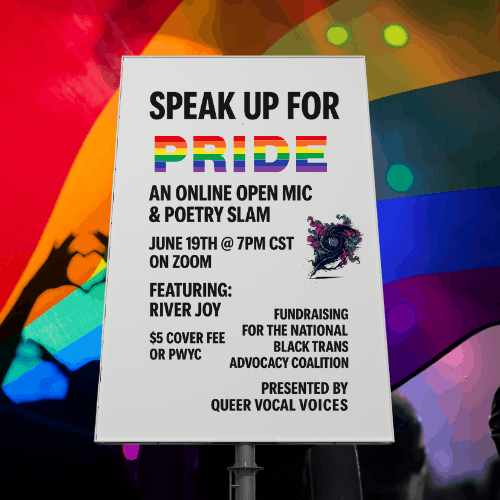
Salt in the Wound will be released on June 19th, the same day River is the featured artist at a Queer Vocal Voices Open Mic benefiting the Black Trans Coalition. (Link to come.)
Thank you for singing when your throat was raw.
Thank you for writing when the world said “don’t look.”
Thank you for reminding us that art is not a luxury — it’s a lifeline.
And to everyone reading: keep making things. Keep bearing witness.
The invader is still here.
But so are we.
Bella ciao.
Feed the Paws…
💜 Help keep the chaos caffeinated and the cats in biscuits. Every crumb helps. Whether you’re funding feline existential monologues, glitchy portals, or late-night creativity spirals, your support feeds the moglets (and occasionally, the magic). 🐈⬛
Make a monthly donation
Make a yearly donation
Choose an amount
Or enter a custom amount
Thank you, fellow wanderer. Your generosity has been noted in the Book of Kindness, which the cats may or may not use as a pillow.
Your contribution is appreciated.
Your contribution is appreciated.
DonateDonate monthlyDonate yearlyDiscover more from River and Celia Underland
Subscribe to get the latest posts sent to your email.
