

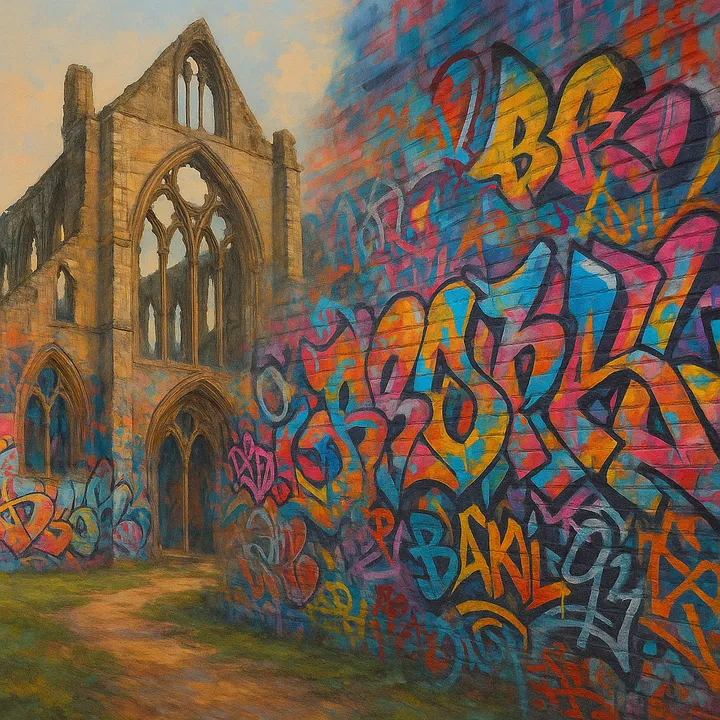
Why the Personal Isn’t the Enemy of the Profound
Modern poetry has been pronounced dead more times than it’s been read.
One web crawling critic after another swings the tired quill of “real poetry” versus “today’s narcissistic drivel,” as if quoting Eliot or Shelley is enough to silence an entire generation. Declaring it blanket ‘awful’ like Roger Joseph Ebert without the clout. These critiques are, frankly, just another version of “Kids these days…” or “Rap music isn’t real music.” Also known as the “I don’t get it, therefore it must be invalid” school of argument.
Most of these self-important takes go something like this:
Modern poetry is shallow. Obsessed with identity. Driven by ego. Stripped of spiritual or intellectual depth. What used to be sacred is now Insta-branded and scrollable. The old, bearded bard-gods are rolling in their graves.
But here’s the truth:
Modern poetry is not the death of poetry.
It’s the mirror.
The reflection of the world we live in.
Just as poetry has always been.
Wordsworth sat on a hill by Tintern Abbey contemplating his own existential relevance. Keats couldn’t stop writing about death and how deeply he felt things. Blake was tearing down empire with prophetic fire. Let’s not pretend navel-gazing, personal experience, or political rage are new to the art form.
Poetry has always been emotional. Always been political. Always been personal.
The world has changed, so the lens has changed.
Thankfully.
Voices once excluded are now amplified. Socio-linguistically, poetry has never been more layered or more alive. Black poets like Benjamin Zephaniah and Amanda Gorman. South Asian voices like Rupi Kaur, Nikita Gill, Arundhathi Subramaniam. Queer and trans poets like Danez Smith, Joshua Jennifer Espinoza, Andrea Gibson and Jayy Dodd write their bodies back into the world. Indigenous poets like Natalie Diaz, Selina Boan, and Craig Santos Perez speak their languages across page and performance.
This isn’t the dilution of poetry. It’s its expansion.
And to those who feel left behind:
The world moved on.
You didn’t.
The Personal Is the Universal
There seems to be a rather strange notion floating around that if a poem is about you — your personal existence-then it is merely a self-indulgent journal entry. Line breaks for paragraphs. Twaddle.
Except, when Ocean Vuong writes about grief and migration, or when Ada Limón speaks of wanting to survive with joy, or when a teenager writes a single trembling couplet about the body they no longer recognise. These aren’t small, “parochial dramas.” They are how we access the big stuff: fear, love, death, transformation. They are how we navigate the world. How we have always navigated it. Except now the personal issues aren’t confined to plants and the agony of Browning’s temporarily vanished husband, “I do not think of thee — I am too near thee.” How self-absorbed, don’t you think?
If you can’t see the universal in the particular, that’s not the poet’s failure. It’s yours.
Quoting the Dead Doesn’t Make You Right
Dragging out T.S. Eliot to scold modern poets is like citing Freud in a conversation about trauma without acknowledging that empirical evidence is now the foundation of psychological research. Eliot’s The Waste Land is arguably the greatest poetic masterpiece of all time. Yet it is fragmented. Line breaks akimbo. It is not tidy and neat. It reflects the post-war geography of Europe, and the ideological fissures left behind once the soldiers had retreated. It is choppy. And bitty. And broken. And that is the point. It too was wildly criticised when it was first published. And let’s not conveniently forget that Shelley and Coleridge were once accused of being too personal, too radical, and too much for their time. The old isn’t wrong. They are part of a journey and so are modern poets. Self-proclaimed or otherwise.
The canon is not a fence. It’s a foundation. You don’t honour it by sneering at those building new floors and exploring new ways to express the human experience.
Art Mirrors This Too
This panic over modern poetry being “too personal,” “too trendy,” or “too rooted in identity” is not unique to poetry. It’s mirrored across the art world.
How many times has a new movement arrived, only to be met with the exhausted complaint that it doesn’t measure up to what came before?
Colour photography, for example, was long dismissed as frivolous, good for birthday parties and travel brochures, but not for “real” art. When William Eggleston’s colour photographs debuted at MoMA in 1976, critics sneered. Hilton Kramer famously called them “perfectly banal.” And yet today, Eggleston is hailed as one of the fathers of modern photography. His work didn’t lack depth; it simply asked viewers to see depth where they’d been trained not to look. Ordinary scenes. Supermarkets. Driveways. The real world, in saturated colour.
Ana Mendieta was also met with raised eyebrows and lazy categorisations: “too emotional,” “too feminist,” “too strange.” Her work, much of it made from blood, fire, and the outline of her own body was dismissed as self-indulgent. But to accuse art (or poetry) like Mendieta’s of being “too individualistic” is to fundamentally miss the point: she had to use herself. The galleries, the archives, the institutions had already erased women like her. She carved her story into landscapes because there was nowhere else it would be kept. Only in recent decades, long after her death, have major retrospectives begun to honour her as a visionary of performance, land art, and postcolonial resistance.
And Alice Neel? She painted people real people. Pregnant bodies. Queer couples. Civil rights leaders. Fat bodies. Children. In a time when the art world was drunk on Abstract Expressionism, Neel’s insistence on the figurative was treated as a weakness. Her portraits were “too intimate,” “too political,” “too raw.” For decades, she painted in relative obscurity. Then, late in her life, and even more so after her death in 1984, her work was rediscovered. By 2021, the Metropolitan Museum of Art devoted a full-scale retrospective to her, calling her one of the great American portraitists of the 20th century.
The point here isn’t just redemption. It’s pattern.
What all these artists share is not just that they were misunderstood, but that they were dismissed because they centred perspectives the gatekeepers found uncomfortable. Because their work was deeply personal. Feminist. Political. Queer. Real.
So, when people complain that modern poetry (or art) is “too identity-based,” what they often mean is: “This isn’t the kind of identity I find comfortable.”
You Don’t Own the Gate Anymore
Much of the disdain for modern poetry, especially Instapoetry or spoken word, is rooted in the horror that poetry no longer needs permission. You don’t need an MFA to write it. You don’t need a subscription to The Paris Review to read it. It’s in zines, open mics, subways, and — yes — Instagram grids.
That doesn’t make it lesser. That makes it alive. Accessible.
Accessibility isn’t dilution. It’s expansion over elitism. If a poem written in under 30 words on a phone screen cracks something open in someone — who are you to say it didn’t succeed? Who are you to define what poetry is? And what it is not?
Purity is a Myth
Let’s talk about transcendence. The idea that real poetry must rise above the everyday, must resist being “temporal” or “trendy” or tied to identity, is nonsense wrapped in velvet pretention.
Transcendence doesn’t mean speaking in riddles. It means seeing through things. It’s the way a single metaphor can collapse centuries into a single moment. It’s not about abandoning the world — it’s about piercing into it.
And no, that doesn’t require a beard, a pipe, and a bookshelf full of Yeats. Just a heart.
The Screen Is Not the Enemy
The screen didn’t kill poetry. It gave it a megaphone. For every “cliché-ridden caption” out there, there’s someone who discovered poetry for the first time on their phone — someone who found Nayyirah Waheed before they found Neruda.
We’re in the middle of a poetry revival, not a funeral. People are writing again. Reading again. Crying over stanzas in comment sections. That’s not a threat to poetry. Rather than seeking to belittle it, why not engage, why not try to understand it from the vantage point of leaning instead of seeking to define it by what came before?
The Poet Is Not a Prophet. They’re a Person.
The myth of the tortured male genius scribbling revelations from the mountaintop is outdated, exclusionary, and boring.
The poet isn’t a holy vessel. They’re a human being trying to say something true. Sometimes they whisper it. Sometimes they scream it. Sometimes it comes in a rhymed sonnet. Sometimes it comes in a broken, breathless spill of words on a late-night blog post.
What matters is that it comes at all.
Why It Matters
Modern poetry matters because it is intimate. Immediate. Messy. Brave. It matters because it tells the truth in the language people actually use. It matters because it refuses to die. Because in a world spinning fast and cracking apart, people still turn to words to understand the shatter.
To say modern poetry lacks value because it doesn’t resemble the past is to mistake tradition for ossification. It’s not poetry’s job to make you comfortable. It’s not its job to flatter your intellect or stay safely within the forms you were taught to respect. It’s here to cut. To heal. To shake something loose.
And if that happens on a phone screen, or in a notebook, or through the voice of someone you didn’t expect could be a poet?
Good.
That means it’s working.
“You do not just wake up and become the butterfly — Growth is a process.” — Rupi Kaur
Maybe if you took a moment to spread your wings instead of cowering on a leaf staring back at the yew trees, you too would see the changing landscape and feel the subtle shift in the wind.
Sonnet I: How Do I Form Thee?
You want it neat — how quaint. How very cute.
A rhyming corpse shoved into Sunday dress.
Life disguised as art. Watercolour paint.
Mess scrubbed clean, truth blended to excess.
You want the scream subdued into a lie,
The rage rhyming, and shoved in a vignette
A pretty hell to frame and classify —
Not something raw enough to be a threat.
My art was never meant for gentle hands.
It bites. It breaks. It does not ask for grace.
You don’t get to shrink, or clean, or demand,
Teach to wear a more acceptable face.
So choke on this: what blooms beneath the skin
Is not yours to tame, trim or tuck back in.
If this resonated, share it on Bluesky (or anywhere folks still have an attention span longer than a moth after a sleepless night), leave us a comment, or check out our latest anthologies
Poetry Collection, ‘Is this all we get?’
Prose Collection, ‘ Fifth Avenue Pizza’
SALT
in the wound
An Anthology of Justice, Equality, and Resistance
We are seeking work that burns.
Salt in the Wound is a forthcoming anthology of poetry, prose, nonfiction, and hybrid forms on the themes of justice, equality, and resistance. This collection is for the words that won’t stay quiet. The truths that refuse to scab over. The ones that bleed, bite, and insist on being heard.
If you’ve been told your voice is too political, too angry, too queer, too much—good. Send it.
▼ What to Submit:
- Poetry (any form)
- Nonfiction (memoir, essay, reflection, critique)
- Short Prose (flash fiction, lyrical narrative)
- Hybrid (fragmented, found, uncategorisable)
- Up to 3 pieces total
- Poetry: up to 3 pages each
- Prose: up to 2,500 words each
▼ How to Submit:
- Attach your work as a .doc, .docx, or .pdf
- Email to: riverandceliainunderland@gmail.com
- Use subject line: Salt in the Wound Submission
- Deadline: 16th June 2025
- No bios. No cover letters. Just your words.
▼ Equity in Action:
$1 from every copy sold will go to the Black Trans Coalition.
Because justice should be more than a metaphor.
Spread this call far and wide. Share with the loud. The silenced. The grieving. The furious.
LET’S MAKE SOMETHING UNIGNORABLE.
☍ The Underland Review
Out Now.
Read it…
And Weep.
The Underland Review: Issue One – This Zine Is a Lie is now live.
57 pages of soft monsters, glitch-lit poetry, haunted prose, cursed diagrams, and art that shouldn’t exist but does anyway. A digital archive stitched together with pocket lint, rage, and love.
☍ READ THE ZINE
Free to read, cursed to absorb. Share it with your coven, your nemesis, your local librarian.
☍ DOWNLOAD THE ZINE (Pay What You Want)
Keep a high-res PDF in your glitch archive. Every donation helps us print more, distribute wider, and one day pay the beautiful liars who make this possible.
☍ ORDER A PRINT COPY ($5.55 + your soul)
Hold the lie in your hands. Smell the ink. Feel the contradiction.
☍ Submissions for Issue Two Are Open
Deadline: Midnight August 10th, 2025
We’re seeking: poetry, prose, essays, visual art, sound pieces, spoken word, and other beautiful misfits. If it glitches, bleeds, howls, or doesn’t fit in polite company — we want it.
We accept text, image, and audio formats. MP3s, JPGs, PDFs, .docx, strange attachments — bring us your fragments. Collaborative works are welcome.
Email us at: riverandceliainunderland@gmail.com
Subject line: THIS IS A LIE – [Your Name]
Thank you for reading. Thank you for believing in beautiful contradictions.
We were never here.
— River & Celia
Curators of Lies, Underland Division
Discover more from River and Celia Underland
Subscribe to get the latest posts sent to your email.
