

INSTALLATION LOG // >
Exhibit Entry Twenty-Two Distortion Dialogue
Still reporting. Still breathing. Still here.
In Gaza, journalism isn’t a job.
It’s a risk. A target. A heartbeat.
To tell the truth is to gamble your life against the odds.
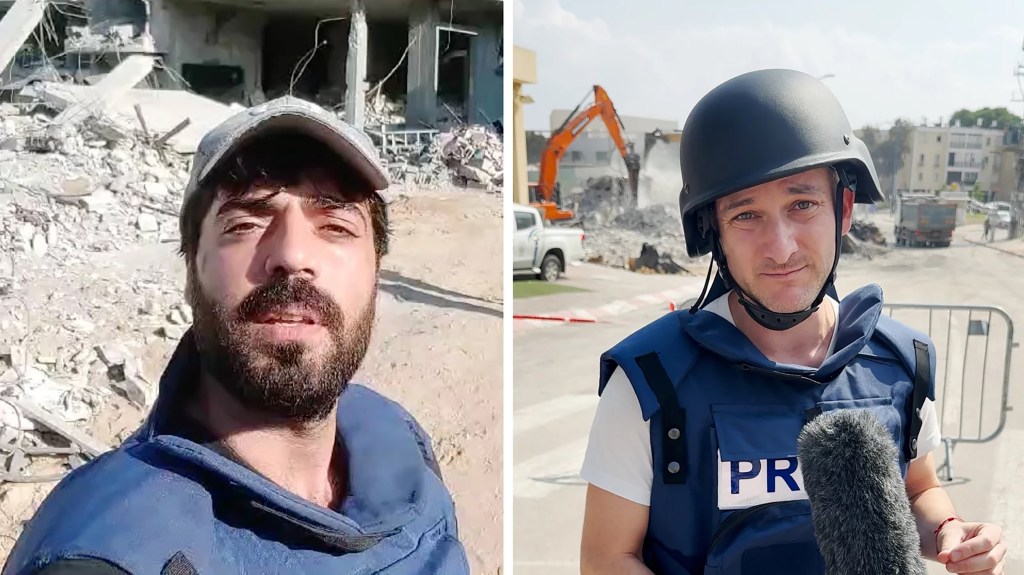
And Anas Baba is still doing it.
A Palestinian journalist and NPR’s producer on the ground in Gaza, Baba is one of the few remaining correspondents for a major Western outlet still in the Strip. Not covering from afar. Not watching from a neighboring country. There. With his people. Living what he reports.
Born in Rafah, he grew up under siege and under curfew, the son of a photojournalist. His earliest memories are shaped by checkpoints and shutter clicks. At 10, he began accompanying his father in the field, carrying cameras and learning how to work with subjects, find camera angles, and stay safe. At 18, he started working with international outlets—AFP, The Guardian—and never stopped. He earned bachelor’s degrees in journalism and English literature from Al-Azhar University in Gaza City. He became a full-time producer for NPR in 2024, bringing a vital, local voice to a network that, like most U.S. media, has historically viewed Palestine through imported lenses.
But Anas didn’t import anything.
He brought presence. He brought nuance. He brought truth.
Since October 2023, more than 220 journalists have been killed in Gaza. Most of them Palestinian. Most of them freelance. Most of them undocumented in the headlines of the very institutions they worked for. Anas Baba is not only surviving that list—he’s defying it.
“Every day, every hour, every moment, I feel the responsibility to share what’s happening. Because if I don’t, maybe no one will.”
Through NPR, he has reported on families crushed under rubble, on children surviving without parents, on weddings that turned into funerals. But he’s also reported on the living: the people hanging up art in refugee tents. The kids playing football on top of collapsed buildings. The woman who refused to leave her cat behind. The humanness of Gaza that refuses to be reduced.
In January 2024, Baba’s reporting helped NPR win a duPont-Columbia Award, one of journalism’s highest honors. He shared the stage remotely—he couldn’t leave Gaza. Still can’t. Instead, he sent his voice.
And that voice is urgent, poetic, and clear.
He doesn’t just describe explosions—he describes absence. Not just death, but after. The echo in a room no longer full. The shoes left by the door. The names still saved in contacts. He’s a journalist, yes, but he’s also a documentarian of loss. A steward of presence. A keeper of names.
And he’s still reporting. Still breathing. Still here.
Bearing witness for those who can no longer speak.
And for those who were never given the chance.

Feed the Paws…
💜 Help keep the chaos caffeinated and the cats in biscuits. Every crumb helps. Whether you’re funding feline existential monologues, glitchy portals, or late-night creativity spirals, your support feeds the moglets (and occasionally, the magic). 🐈⬛
Make a monthly donation
Make a yearly donation
Choose an amount
Or enter a custom amount
Thank you, fellow wanderer. Your generosity has been noted in the Book of Kindness, which the cats may or may not use as a pillow.
Your contribution is appreciated.
Your contribution is appreciated.
DonateDonate monthlyDonate yearlyDiscover more from River and Celia Underland
Subscribe to get the latest posts sent to your email.
