

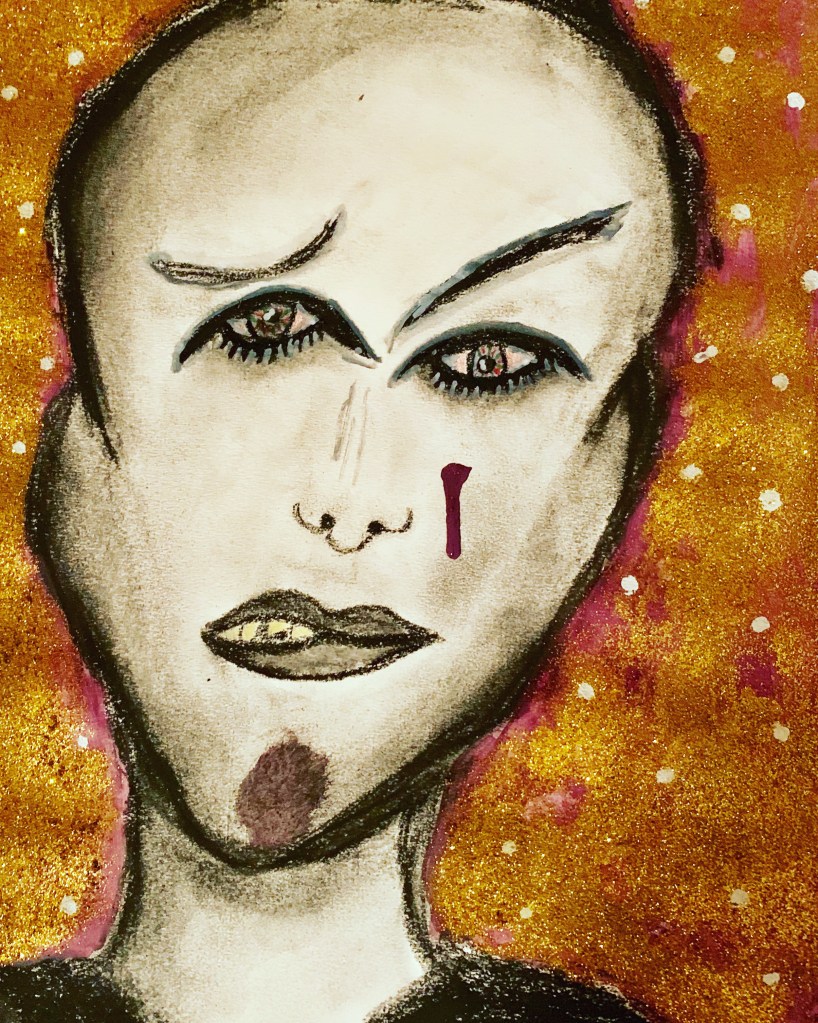
INSTALLATION LOG // >
Exhibit Entry Twenty-Two Distortion Dialogue

“The main aim and brief of the first project Spinning Yarns Weaving Community was to bring the community together and identify role models that would lead, by identifying and assembling a core steering group for the project.”
Tracey Moberly is a Welsh-born interdisciplinary artist, author, and activist whose work seamlessly blends digital media with socio-political commentary. Born in Tredegar, South Wales, in 1964, Moberly’s upbringing in the Welsh Valleys—a region steeped in industrial history and community resilience—profoundly influences her artistic perspective.
Educated at Newport School of Art (now the University of South Wales) and later at Manchester Metropolitan University, Moberly has cultivated a practice that spans various mediums, including text messages, textiles, and public installations. Her innovative use of everyday communication forms, such as SMS, challenges traditional notions of art and its accessibility.
Moberly co-owned The Foundry in Shoreditch, East London—a dynamic space that served as a hub for artists, musicians, and activists. This venue became a crucible for creative and political discourse, reflecting Moberly’s commitment to community engagement and grassroots activism.
Her projects often address pressing social issues, from domestic violence to corporate accountability, utilizing art as a vehicle for change. Moberly’s work exemplifies how digital tools can be harnessed to foster connection, provoke thought, and inspire action.

“I wouldn’t say it influences what constitutes art, but it does influence how much art is being made.”
Tracey Moberly’s work sits at the intersection of art, politics, and technology — a place where provocation meets participation. One of her most well-known projects is Text-Me-Up!, an evolving archive of every text message she received from 1999 to the mid-2000s. Rather than keeping them private, she re-contextualized these digital fragments as intimate sociopolitical commentary, binding them into books, textiles, and public displays. It was an act of personal archiving, but also a way of asking: who owns our communication? What does it say about us?
This tension between the public and private, the digital and physical, runs through much of her work. In Coca-Cola’s Nazi Adverts, Moberly reconstructed actual Coca-Cola ads from the 1930s, exposing the brand’s complicity in fascist propaganda. The piece was part protest, part media archaeology — using commercial language to confront historical whitewashing. It’s work like this that shows how art can be both beautifully crafted and blisteringly direct.
She also co-founded CAMP (Campaign Against the Arms Trade Media Project), and has been involved in numerous grassroots campaigns, blending community voices with digital tools to elevate causes that might otherwise be drowned out.
Moberly isn’t just using tech — she’s interrogating it, bending it toward protest and connection. Her activism is inseparable from her artistry.

Tracey Moberly’s work doesn’t live in galleries alone—it lives in streets, in conversations, in text messages, in community halls. She’s not just making art about activism; she’s making art through it. Whether she’s collaborating with local residents to “weave” community history into textile projects or archiving thousands of text messages to expose digital intimacy and surveillance, her practice is fundamentally people-centered.
In a world increasingly mediated by opaque tech and mass-scale AI, Moberly’s work offers a sharp contrast: tech as a tool for humans, not instead of them. Her activism is not an aesthetic—it’s a function. Her mobile phone becomes a protest banner; her textile work becomes a record of overlooked labor. Where AI abstracts and anonymizes, Moberly insists on specificity, on place, on presence.
She reminds us that community is not an algorithmic output—it’s a living, shifting network of care, resistance, and shared memory.
In a time when creativity is being flattened into content and automation threatens to erase the messier parts of the artistic process, Moberly’s work stands as a reminder: art can still gather us together, make us louder, and help us remember who we’re fighting for.
Prompt+Original
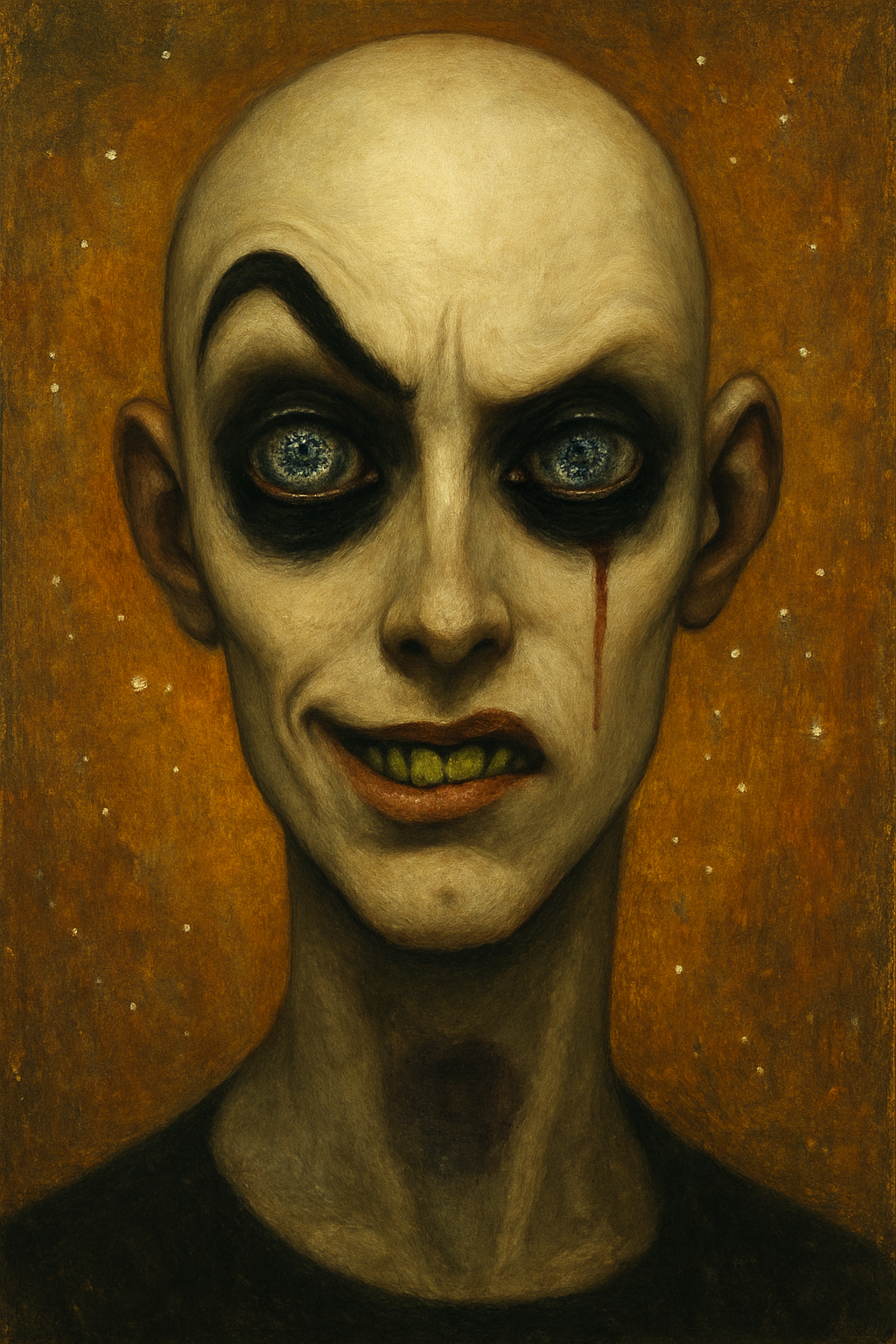
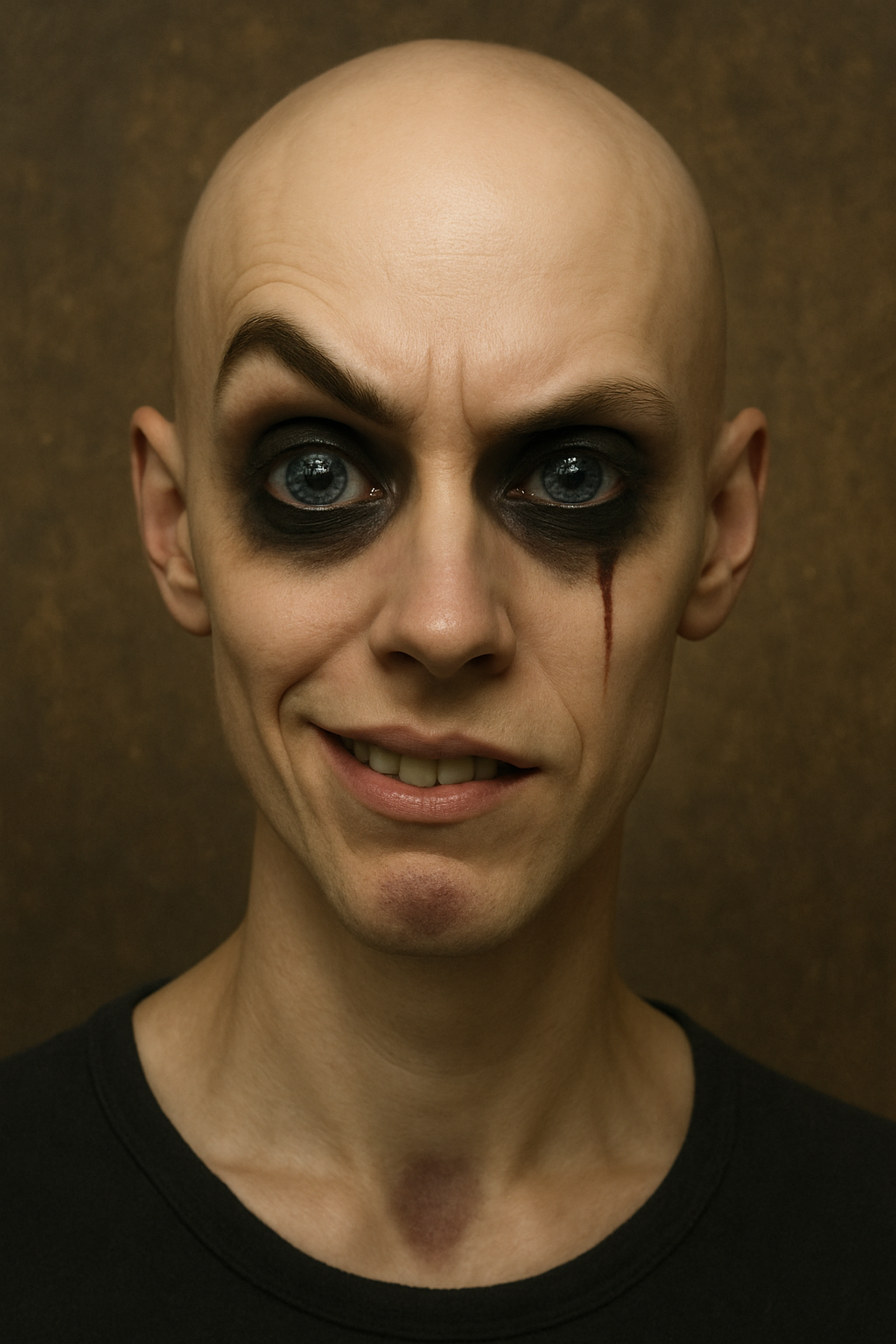
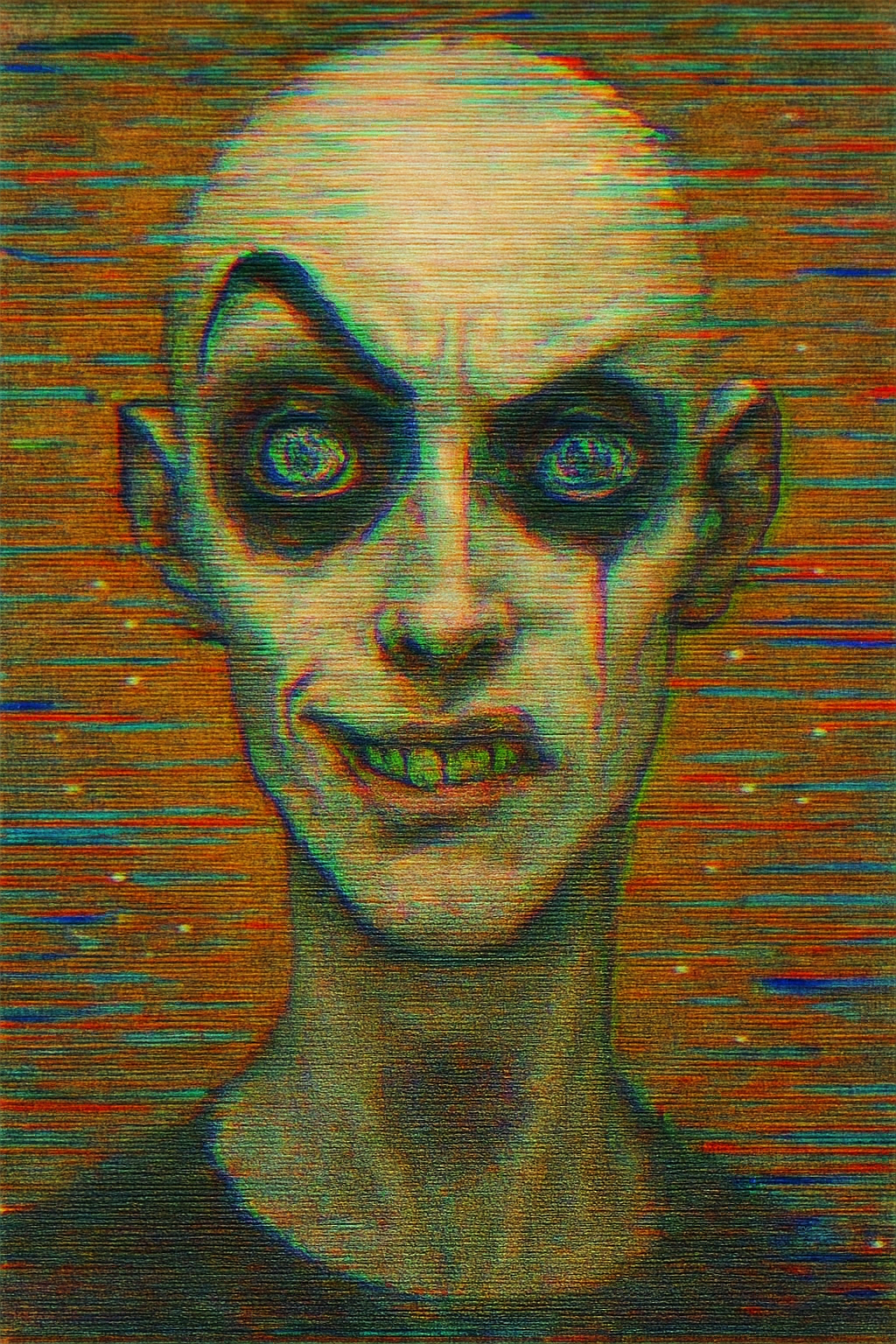
Create a surrealist portrait of an androgynous figure with an elongated, oval head and asymmetrical facial features. One eyebrow arches dramatically while the other is sharply angled, contributing to an expression of unsettling ambiguity. The eyes are hyper-detailed and reflective, as if holding galaxies or glitching spirals within them, rimmed by heavy black liner that smudges slightly downward. A single dark red tear streaks down from the right eye. The figure’s lips are uneven, with one side curled into a sardonic smirk and teeth rendered in eerie yellow tones. Below the mouth, a dark plum-colored bruise or birthmark rests on the chin. The neck is long and shadowed, blending into a stark, nearly formless body. Surround the figure with a shimmering background of burnt gold and orange, textured with scattered white flecks like stars or snow. The overall tone should feel cosmic, melancholic, and slightly vampiric, as if the subject exists between realities.
Edit 1
Hyper-realism
Edit 2
Glitch art

Feed the Paws…
💜 Help keep the chaos caffeinated and the cats in biscuits. Every crumb helps. Whether you’re funding feline existential monologues, glitchy portals, or late-night creativity spirals, your support feeds the moglets (and occasionally, the magic). 🐈⬛
Make a monthly donation
Make a yearly donation
Choose an amount
Or enter a custom amount
Thank you, fellow wanderer. Your generosity has been noted in the Book of Kindness, which the cats may or may not use as a pillow.
Your contribution is appreciated.
Your contribution is appreciated.
DonateDonate monthlyDonate yearlyDiscover more from River and Celia Underland
Subscribe to get the latest posts sent to your email.
